Guided access when seconds matter.

Sensing, visualization, and AI-assisted guidance for critical procedures — from battlefield to bedside.
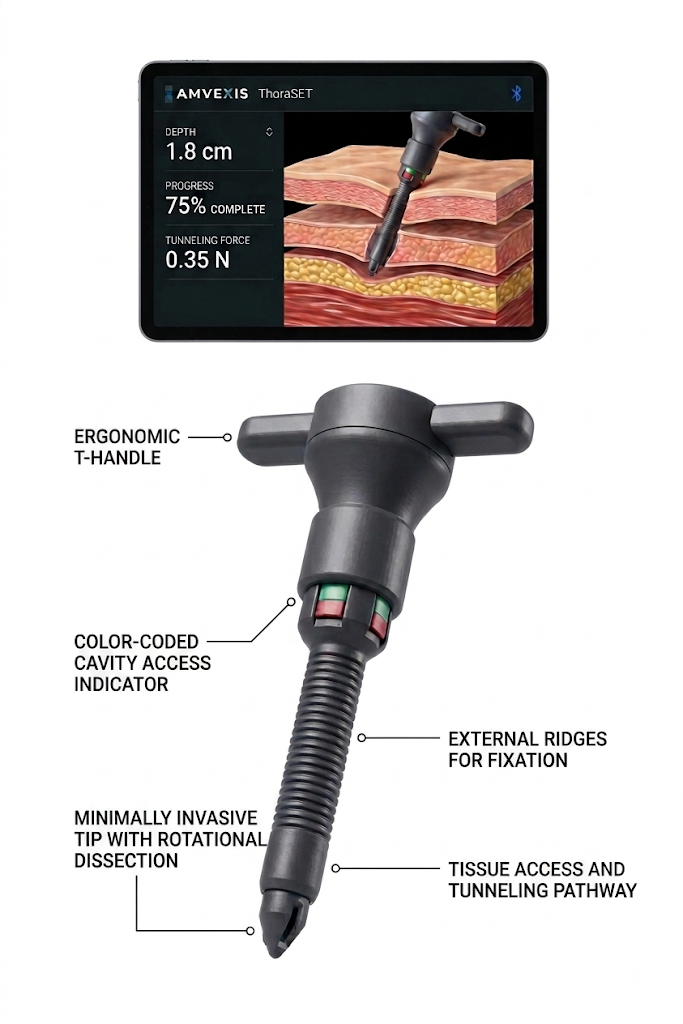
ThoraSET tablet display with real-time depth, progress and tunneling-force readout, and the ThoraSET device with labeled features
The Challenge

Medicine advanced.
Procedural access did not.

High-risk bedside procedures still depend heavily on tactile estimation, line-of-sight limitations and operator experience. The result is persistent variability, preventable complications and hesitation when seconds matter.

1M+
Chest tubes / year
Large U.S. procedural burden across emergency, trauma and critical care settings.
20–30%
Persistent complication rates
Thoracic access complications remain substantial despite decades of training.
300M
Peripheral IVs / year
One of the most common invasive procedures in medicine.
50M
Central lines / year
High-value access where trajectory, depth and first-pass performance matter.
These are not separate problems. They share the same root cause: procedural uncertainty at the point of action.
The Platform

One architecture.
Multiple critical procedures.

The AMVEXIS platform progressively adds information—mechanical, optical, physiologic and computational—without taking the clinician out of the loop.

The paradigm shift · from blind technique to intelligent guidance

Conventional procedure

  • Landmark estimation
  • Tactile-only advancement
  • Operator-dependent interpretation
  • Confirmation after the fact

AMVEXIS procedure

  • Real-time sensing
  • Direct visualization
  • Confidence-aware guidance
  • Safer, faster, more reproducible action
The product portfolio
ThoraSET™ icon
Thoracic access

ThoraSET™

Pressure-sensing thoracostomy technology that provides immediate mechanical feedback during cavity entry, designed to reduce dependence on blind advancement.

MECHANICAL SENSING · PHYSIOLOGICALLY CALIBRATED
OptiSET™ icon
Multimodal access

OptiSET™

Next-generation access platform integrating optical visualization, pressure sensing, and CO₂ detection for real-time procedural awareness.

MULTIMODAL SENSING · REAL-TIME FEEDBACK
SurgAIID™ icon
Intelligence layer

SurgAIID™

Human-in-the-loop clinical decision support designed to interpret multimodal procedural data and provide confidence-aware guidance at the point of care.

SENSOR FUSION · DECISION SUPPORT · EDGE AI
AccuSET™ icon
Vascular access

AccuSET™

Precision needle-to-probe alignment technology for vascular access, using mechanically constrained trajectory and depth control to address the same underlying uncertainty.


PRECISION VASCULAR ACCESS · DISTINCT PLATFORM
Layered intelligence, end to end
MECHANICAL SENSING
MECHANICAL SENSING
VISUALIZATION
VISUALIZATION
PHYSIOLOGIC SENSING
PHYSIOLOGIC SENSING
MULTIMODAL FUSION
MULTIMODAL FUSION
AI-ASSISTED DECISION SUPPORT
HUMAN-IN-THE-LOOP GUIDANCE
Dual-Use Impact

From bedside
to battlefield.

The same technologies that improve civilian procedural consistency become force multipliers in austere environments—where imaging, expertise, time and evacuation are constrained.

Civilian care

Standardize high-risk procedures.

Designed for settings where speed, accuracy and reproducibility directly influence outcomes.

TraumaEmergency MedicineCritical CareEMSRural HospitalsAcute Care Surgery
Military medicine

Level the performance field.

Real-time guidance can reduce cognitive burden and help less experienced users approach expert-level speed and accuracy in prolonged casualty care.

Role I / Role IIProlonged Casualty CareCASEVACDistributed OperationsSOF / PJ / SOIDCAustere Resuscitation
Evidence & Translation

Built in the lab.
Tested with end users.

ThoraSET has progressed through iterative engineering, mannequin and porcine evaluation, clinician testing and military end-user engagement, supported by a growing translational ecosystem.


Invented at Duke
Technology showcase
SCCM C2i2
Critical Care Innovation Incubator
NCBiotech TRG
Translational research funding
MedBlue Incubator
Company development
Gilhuly Accelerator
Duke translational support
Duke New Ventures
Selected candidate company
Supported & engaged with
U.S. Department of Defense National Institutes of Health Duke Innovation & Entrepreneurship
Endorsements

Backed by clinicians
and end users.

AMVEXIS technology has been reviewed and supported by leaders across military and civilian critical care, trauma and emergency medicine.

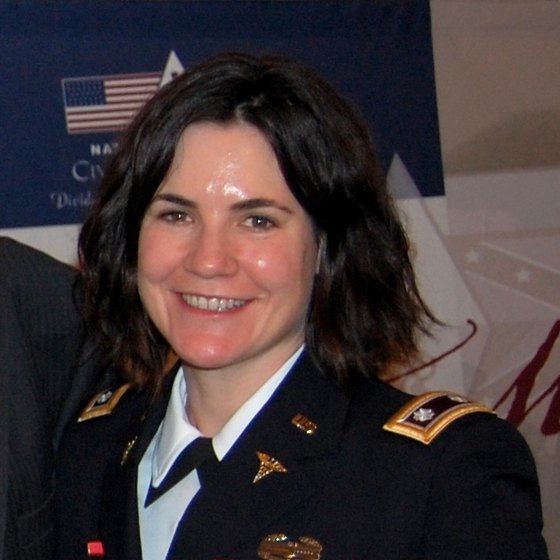
Military medicine
Matt Carlson
Matt Carlson
SOIDC / ATP / NR-P / FP-C
Special Operations Independent Duty Corpsman, U.S. Marine Forces Special Operations Command
Jennifer Gurney
Jennifer Gurney
Chief, Joint Trauma System
Trauma Surgeon, Brooke Army Medical Center
Civilian & hospital
Amy Rezak, M.D.
Amy Rezak, M.D.
Assistant Professor of Surgery
Division of Trauma, Acute & Critical Care Surgery
Duke University Hospital
I see this technology replacing ALL chest tube insertion, not simply those anticipated to be difficult placements.
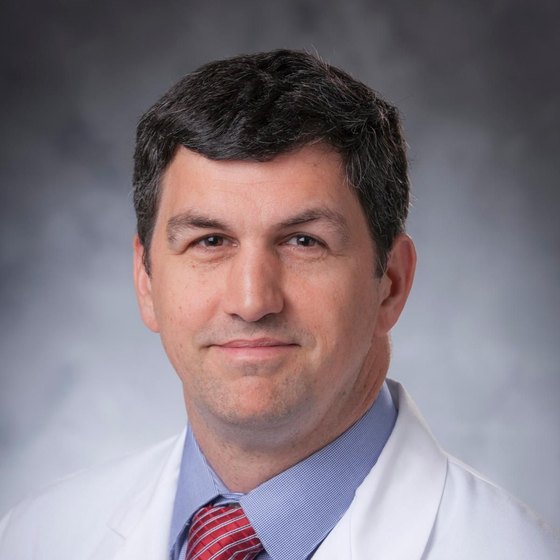
Sean Paul Montgomery
Associate Professor of Surgery
Trauma, Acute & Critical Care Surgery
Surgical Critical Care Fellowship · Duke University Hospital
I am confident that this technology will replace 100% of chest tube placements performed in emergent and urgent settings within military environments.
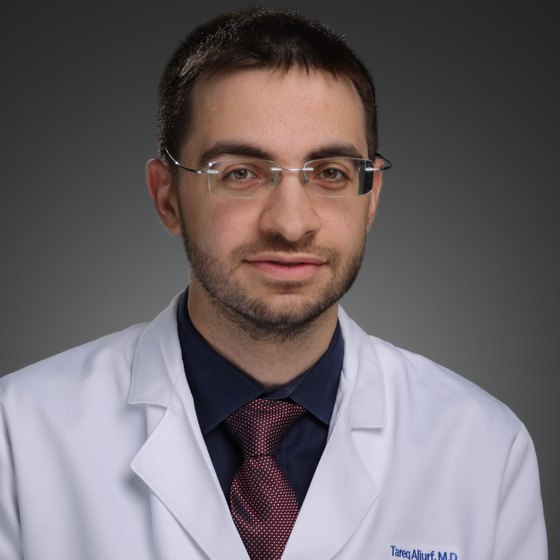
Tareq Aljurf, M.D.
Tareq Aljurf, M.D.
Pulmonary & Critical Care Medicine Fellow
Division of Pulmonary, Allergy & Critical Care Medicine
Duke University Hospital
This technology has the potential to become the new standard for chest tube placement.
The Team

Built by clinicians and engineers.

AMVEXIS was invented at the intersection of critical-care medicine and medical-device engineering.
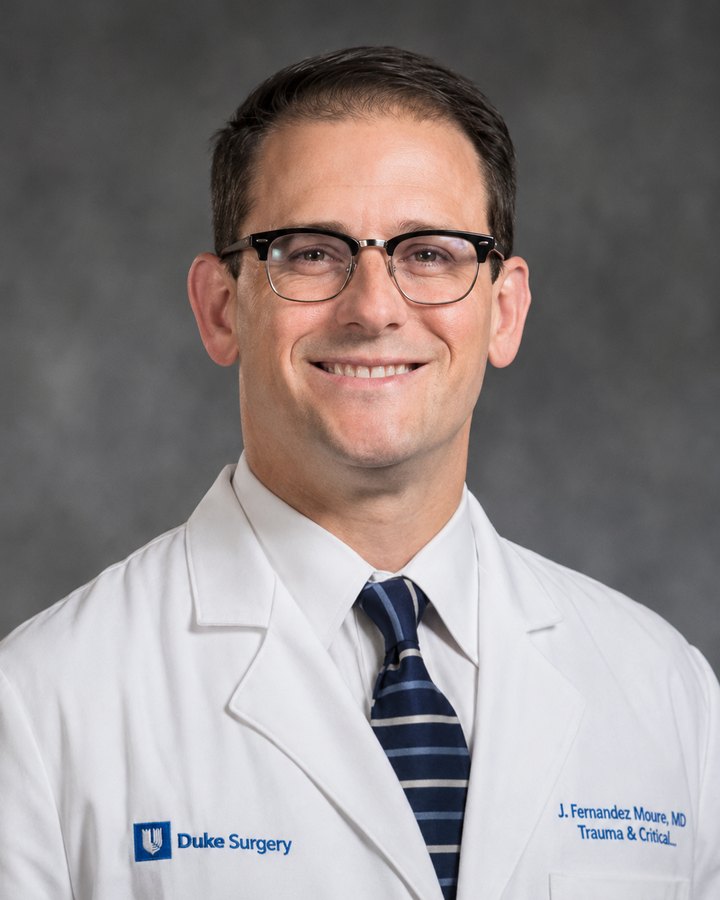

Joseph Fernandez-Moure, M.D., M.S.

Joseph Fernandez-Moure, M.D., M.S.

Chief Executive Officer · Co-Founder
Associate Professor of Surgery — Trauma, Acute & Critical Care Surgery · Surgical Critical Care Fellowship
Jake Peloquin, Ph.D.

Jake Peloquin, Ph.D.

Chief Technology Officer · Co-Founder
Professor, Edward P. Fitts Department of Industrial and Systems Engineering, North Carolina State University
Connect with us

Guidance at the point of action.

Guided procedural systems designed to make life-saving interventions safer, faster and more reliable—from battlefield to bedside. Reach out to learn more, partner, or evaluate the technology.

Trauma·Critical Care·Emergency Medicine·Surgery·Military Medicine·Austere Care